
Calf muscles are not as simple as you might think! Above are a couple of the major players: Gastrocnemius (Gastrox) and Soleus.
Gastrox- *sits on top of soleus. It's what you feel at the the top of your calf.
Bends the knee and moves the ankle in the action that points your toes (or when you stand on your tip toes).
Soleus- *sits underneath gastrox, closer to the bone. You can feel it at the bottom of the calf area.
Doesn't do anything at the knee. It works with the gastrox and does the same thing (point the toes/stand on tip toes). This movement is called plantar flexion (like planting your foot on the accelerator).
Both of these muscles join onto the Achilles tendon which joins onto the heel bone (Calcaneus).

The fascia:
The connective tissue for these muscles (fascia) runs all the way from under the foot, up over the back of the leg, over the bum and up the back to the neck and head. See below.

This fascia acts as a support when you're standing/bending forward etc. It runs down over the Sacroiliac (SI) joint, and has an effect here if dysfunctional (tight etc). See below for a pic of the SI joint. This picture, although depicting SI joint pain, hopefully shows where the joint is relative to the rest of the body. Note that it joins your spine (via your sacrum) to your hip bones.

So, if you have tight calves, it might be a good idea to stretch out your hamstrings and glutes as well! This stretching can also have a positive effect on the low back area via fascial release. Need I mention a foam roller as a beneficial self treatment? ;-)
The calf fascia also wraps all the way around your shin to encompass the whole lower leg. It has attachments along the lower leg bones from the knee to the ankle. This forms compartments, inside which the muscles live. See below.

This fascia isn't very stretchy at all, and doesn't leave much room for swelling etc in the event of an injury. This is what compartment syndrome is all about. More info on compartment syndrome can be found here:
http://www.ncbi.nlm.nih.gov/pubmedhealth/PMH0002204/
Effects of dysfunction within the calf muscles:
- Local pain- Referred pain (see common trigger point referral areas below)
- Weakness in the muscles (from trigger points). This effects plantar flexion and hence pushing off from your toes when you run.
- Joint stiffness around the ankle/knee as the muscles are too tight to allow it to move properly.
- Higher susceptibility to injury (strains/tears etc)
- Tightness transferred through the fascia, all the way up the back of the body, effecting connected muscles (especially hamstrings) and joints.
- Increased risk of plantar fasciitis, heel spurs, calcaneal bursitis, compartment syndrome, shin splints etc.
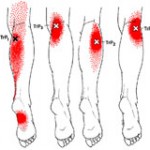
What to do about helping yourself maintain good calf muscle/fascia integrity?
1. Self myofascial release/ Trigger point therapy using your foam roller (see below)
2. Stretch twice a week using PNF technique (see below)
3. See me for treatment so I can help break the pain cycle and make sure joints etc are being given some attention.
How to roll out your calves and hamstrings with your foam roller:
Below is a YouTube clip of a guy using a tennis ball and a foam roller. He covers other muscles, not covered in this discussion but copy him because it all looks good. The only suggestions I'd make are:1. Roll slowly. The nerves in the fascia/muscles respond to slow, sustained pressure (like how I massage you).
2. When you find a trigger point (notably the spot where the pain is exquisite), linger on it until the pain dulls. Roll off it, and then back onto it until the pain goes away. You can also roll over it backwards and forwards, but I find the first technique works well.
3. I'd use the broad foam roller first (self myofascial release) then I'd use the tennis ball to get the trigger points and into the skinny bits of the lower leg.
*note. When the clip says gastrocs and soleus, he's actually working on Tibialis Anterior muscle...so don't get confused there! haha.
Some good ideas!
How to stretch gastrox and soleus using PNF technique:
PNF general instructions:1. Go into the stretch and hold for 10 seconds
2. Push in the opposite direction that you're pulling yourself into, to achieve a stretch, for 8 seconds. You can use a wall or the floor for resistance or even a pair of pants wrapped around your foot instead of the cord shown in the clip.
3. Breathe in and out, and then pull yourself into a stretch again.
4. Repeat this process 3 times.
Note: This stretch is quite an intense technique in terms of stress on the muscles, so only do it perhaps twice a week (and not if you have an injury!). Other days it's fine to just do normal stretching, without the contractions.

No comments:
Post a Comment