QL (Quadratus Lumborum) Muscle
Introducing the QL muscle:

This muscle begins on your hip bones at the back, and attaches onto your bottom rib and the edges of your spine in the low back region.
QL helps with hoicking one hip and side bending, and also assists when you lean backwards. It's put under stress if it has to slow you down/stop you from collapsing, as you bend to the opposite side or forwards (or a combination of both).
It is also under stress if it has to support you in a forward position, such as when you ride a road bike. Note, lifting something and twisting can also hurt QL. Lifting and twisting is never a good idea anyway!
As you can see, this muscle has a lot of responsibility and can complain if it's overused/abused.
See below a common pattern of referred pain from trigger points in the QL muscle:

The Fascia (connective tissue) that effects QL:
Across the low back region, there is a broad, flat expanse of connective tissue called the Thoracolumbar aponeurosis. Several muscles attach to it, including transverse abdominus (wraps around your stomach and back), internal oblique, glute max, lats, erector spinae (runs up either side of your spine), multifidus (in between spinal segments) and biceps femoris (hamstring). There are 3 layers to the fascia: anterior (front), middle and posterior (back). The anterior layer covers the anterior aspect of the QL muscles. (Lee, D. 2004)
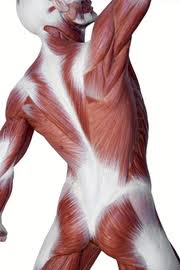
The thoracolumbar fascia is used to transfer load from the trunk to the legs. (Schleip, R. et al, 2012) Here is a rough idea of how it all connects up when we move.


A good way of self-treating QL:
Note* You can roll a little further onto your back as well.
Remember- Roll slowly. The nerves in the fascia and muscles react to slow sustained pressure (at least 6 seconds). I would roll at about half the pace shown in the clip.
Make sure you settle onto any exquisitely sore points (trigger points) until the pain subsides. Roll off the spot, then back onto it, until the pain recedes again.
After foam roller work, you can stretch as shown below:
If your hamstrings are restricting you in this position, stretch them out first. :-)
This stretch is good because you can just relax into it.
Alternative QL stretches will be added to this blog in the future. :-) Watch this space...
Enjoy!
References:
"Fascia- The tensional network of the human body", Schleip, R. Findley, T. Chaitow, L and Huijing, P. 2012.
"The pelvic girdle", Lee, D. 2004.

No comments:
Post a Comment